
Senior living is often discussed as one category. It is really several, each defined by how much support a resident needs and how that support is delivered. Understanding the differences helps families choose well, and it shapes how a community should be designed, staffed and run.
The distinctions are not only about care. They change the building, the licensing, the staffing model, the dining program, the cost to residents and the way a community earns its keep. A developer who treats the continuum as one product tends to build something that fits none of its residents well. A family that does not know the differences can end up choosing a setting that fits today and fails within a year.
This note walks through each level of care, what it asks of a building and a team, and why the connections between levels matter as much as the levels themselves.
Independent living
Independent living serves older adults who can manage daily life on their own but want a community built around their stage of life: no home maintenance, meals and activities available, neighbors nearby and help close at hand. The care model is light. The design emphasis is on social life, convenience and the ability to stay active.
Many residents choose independent living because the house they raised a family in has become more work than it is worth, or because they want to be closer to people their own age. Loneliness and isolation are real risks in later life, and a well-run community answers them with daily opportunities to see friends, take a class, join a walk or simply eat dinner with others.
Because independent living generally does not include personal care, it is usually lightly regulated compared with the levels that follow. That flexibility is useful, but it means the quality of the experience rests almost entirely on the operator: the dining, the programming, the responsiveness of staff and the upkeep of the building.
Assisted living
Assisted living adds help with activities of daily living, such as bathing, dressing, medication management and mobility. Residents keep private apartments, but staff are present around the clock. Assisted living is licensed and regulated by the states, and the rules on staffing, training and services vary from one state to the next.
The shift from independent to assisted living changes the building in practical ways. Bathrooms need room for a caregiver to help safely. Call systems need to reach staff quickly at any hour. Medication storage and administration need secure, well-organized space. Dining may need to accommodate residents who need help or modified diets, without making anyone feel singled out.
It also changes the team. Caregivers, medication aides and nurses join the staff, and the community needs a plan for how residents are assessed when they move in, how their needs are reviewed over time and how changes are communicated to families. Each resident typically has a service plan, and the quality of that plan, and how faithfully it is followed, is a large part of what families are paying for.
Memory care
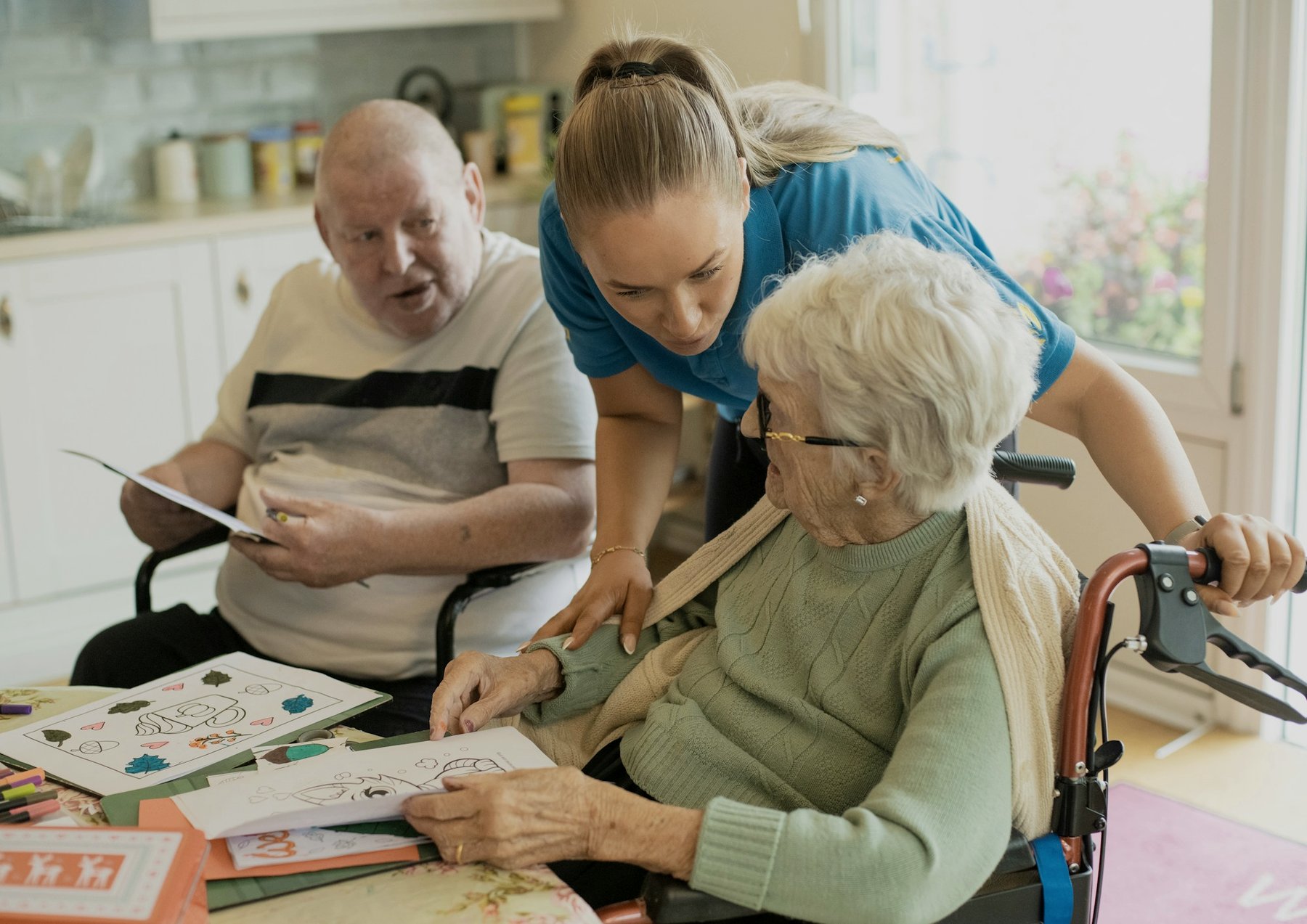
Memory care serves people living with Alzheimer's disease and other forms of dementia. It requires secure environments, staff trained specifically in dementia care, structured routines and spaces designed to reduce confusion and agitation. It is the most demanding part of the continuum to operate well, and the part where operating quality matters most to residents and families.
Dementia affects memory, judgment, communication and the ability to navigate a space, and it progresses differently for each person. Good memory care meets residents where they are. Staff learn each person's history, preferences and routines, and use that knowledge to offer reassurance, meaningful activity and choice. Many states set additional requirements for communities that advertise memory care, including staff training and secured environments.
Memory care is usually offered in smaller neighborhoods, either as a dedicated building or as a secured wing within a larger community. The staffing ratio is higher than in assisted living, and the building has to support safety without feeling like confinement. Those requirements make memory care more expensive to build and to run, and they make experienced operators essential.
What the levels have in common, and what they do not
It helps to compare the three levels side by side. The differences show up in nearly every decision a community makes:
- Care: light and on request in independent living; daily personal care in assisted living; specialized, structured dementia care in memory care.
- Regulation: generally lighter for independent living; state licensing for assisted living; often additional state requirements for memory care.
- Staffing: hospitality and life-enrichment teams in independent living; round-the-clock caregivers in assisted living; higher ratios and dementia-specific training in memory care.
- Building: larger apartments and social amenities in independent living; accessible, care-ready apartments in assisted living; small, secured neighborhoods with outdoor access in memory care.
- Pace of change: residents in independent living may stay for years; needs in assisted and memory care tend to change more often and need regular review.
What they share is the purpose. Every level exists to help an older adult live as fully and safely as possible, with dignity and some control over daily life. A community that loses sight of that, at any level, will struggle no matter how good the building looks.
Why the continuum matters
Needs change over time. A resident who moves into independent living may later need assistance, and later still memory care. Communities that offer more than one level of care, or that partner closely with others that do, can make those transitions far less disruptive. Staff already know the resident. The family already knows the staff.
A move between levels of care is one of the hardest moments in a family's life. Good communities make it a short walk, not a new search. The alternative is familiar to many families: a hospital stay or a fall reveals that a parent can no longer live as before, and the family has days, not months, to find a new community, tour it, complete assessments and move belongings, all while managing their own grief and worry.
A move between levels of care is one of the hardest moments in a family's life. Good communities make it a short walk, not a new search.
Continuity also helps the resident. Familiar faces, a familiar dining room and a spouse or friend who lives a few doors away can make a change in care far easier to accept. For couples whose needs differ, a community that offers more than one level of care can let them stay close even when one partner needs more support than the other.
Questions families should ask
Families touring a community can learn a great deal by asking how it handles change, not just how it looks on the day of the visit. A few questions tend to reveal the most:
- What levels of care do you offer on this campus, and what happens if my parent needs a level you do not provide?
- How are residents assessed at move-in, and how often are service plans reviewed?
- What training do caregivers receive, and what additional training do memory care staff receive?
- How do you communicate with families when a resident's needs change?
- How long have the executive director and care leaders been in their roles?
The last question matters more than it seems. Leadership and staff stability are among the best signals of how a community will feel a year after move-in.
What the continuum means for investors
For investors, the continuum is not a marketing phrase. It shapes the risk and the economics of a community. Independent living depends on lifestyle demand and competes partly with staying at home. Assisted living and memory care depend on need, which tends to be steadier, but they carry heavier staffing, licensing and operating demands.
A common mistake is to choose a unit mix to fit a financial model rather than a market. A community with too much independent living in a market that needs care, or too much memory care for the local operator's capacity to staff it, will underperform no matter how well it is built. The right mix starts with careful analysis of the local population, existing supply and the depth of the caregiving workforce nearby.
Another mistake is to underestimate how differently each level must be operated. A strong independent living operator is not automatically a strong memory care operator. The skills, systems and culture are related but distinct, and a community that offers several levels needs leadership that can run all of them well.
How Hearth approaches it
UpManagement Hearth invests in, develops and operates communities across the continuum, in partnership with experienced care operators. The real estate and the care model are planned together from the first sketch, because the right building for memory care is not the right building for independent living, and a community that serves both has to be designed for both.
Hearth selects markets through data-driven analysis of demographics, supply and workforce. It brings the shared UpManagement platform for finance, compliance, legal and technology, and it reports every community on the same monthly standard, including occupancy, safety, margin and capital spend against plan. The goal is simple to state and hard to achieve: communities where residents can age in place as their needs change, and where families can trust that the next step, when it comes, will be a short walk.
Published by UpManagement. This article is general information about the sectors in which the UpManagement companies operate. It is not legal, tax, investment or compliance advice, and it is not an offer to sell or a solicitation of an offer to buy any security. Where a company is described as a platform in formation, its approvals are not yet in place.